


Specialty Power Device Solutions
A power whip typically uses a combination of these components to safely deliver power from the facility distribution panel to the IT racks via rackmount PDUs. In data centers, receptacles, plugs, connectors, and inlets form a complete ecosystem of safe, modular, and scalable power delivery.
- Receptacles provide the fixed power source
- Plugs on whips connect rackmount PDUs to those sources
- Connectors and inlets support modularity and hot-swappable PDUs or equipment
Together, they enable flexible, high-reliability, and serviceable power distribution architectures—critical for maintaining uptime and adaptability.
Built to Match Your Environment and Load Requirements
Available in multiple device types and amperage ranges, these solutions support a wide variety of installation environments—from controlled indoor spaces to raised floors and high-capacity applications.
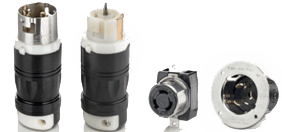
Application
- Indoor controlled → NEMA or IEC
- Raised floor or washdown → IEC 60309 watertight devices
Amperage
- 20–125A → IEC Pin & Sleeve Devices
- 15-60A NEMA Devices
- Up to 400A → Single Pole Cam-Type Devices
Flexibility
- Plugs & connectors enable modular whips and fast changeouts
- Receptacles & inlets provide fixed, code-compliant terminations
Safety
- Ground-first, shrouded designs in IEC and locking NEMA prevent shock hazards
- LOTO-compatible for service work
Power Device Types Overview
Use the table below to quickly compare power device types by function, installation location, and key benefits to help identify the right solution for your power whip application.
| Device Type | Primary Function | Physical Design | Installation Location | Typical Applications | Key Benefits |
|---|---|---|---|---|---|
| Receptacle (Female Device) | Provides the fixed power outlet that accepts a plug to deliver electrical power. | Stationary device with recessed female contacts to prevent accidental touch; mounted in wall boxes, floor boxes, or enclosures. | Fixed end of the power circuit on PDUs, junction boxes, or wall and floor plates. | Outlet point for PDU power whips, server racks, or branch circuits connecting to building power. | Safe, code-compliant termination point; prevents accidental contact and supports lockout/tagout during maintenance. |
| Plug (Male Device) | Portable power input that inserts into a receptacle to draw power. | Male pins enclosed in a shrouded or insulated housing; connects to flexible cable or cord. | Installed on the end of a power whip or equipment cord leading to a PDU or rack. | Enables PDUs or rack power strips to connect to floor or overhead receptacles. | Quick connect and disconnect, standardized configurations (NEMA & IEC), and safe grounding contact sequencing. |
| Connector (Female Cord-End Device) | Provides a female termination on a portable cord that mates with a male inlet. | Recessed female contacts within an insulated, often watertight housing with strain relief. | Installed on power whip cords or extension cables feeding from PDUs or UPS systems. | Used to extend PDU outputs, connect to remote power strips, or link modular distribution components. | Enhances flexibility for moves, adds, and changes; ensures touch-safe design and proper polarity. |
| Inlet (Male Device) | Accepts power from a female connector; power flows into the device. | Male pins in a fixed, recessed housing mounted directly to a panel or enclosure. | Installed on equipment or PDUs to receive incoming power via a whip or connector. | Common on rack PDUs, UPS systems, and modular power equipment. | Enables tool-less field connections and supports fast service replacement or modular power upgrades. |